
GEO vs SEO: What’s the Difference and Why Does It Matter in 2026
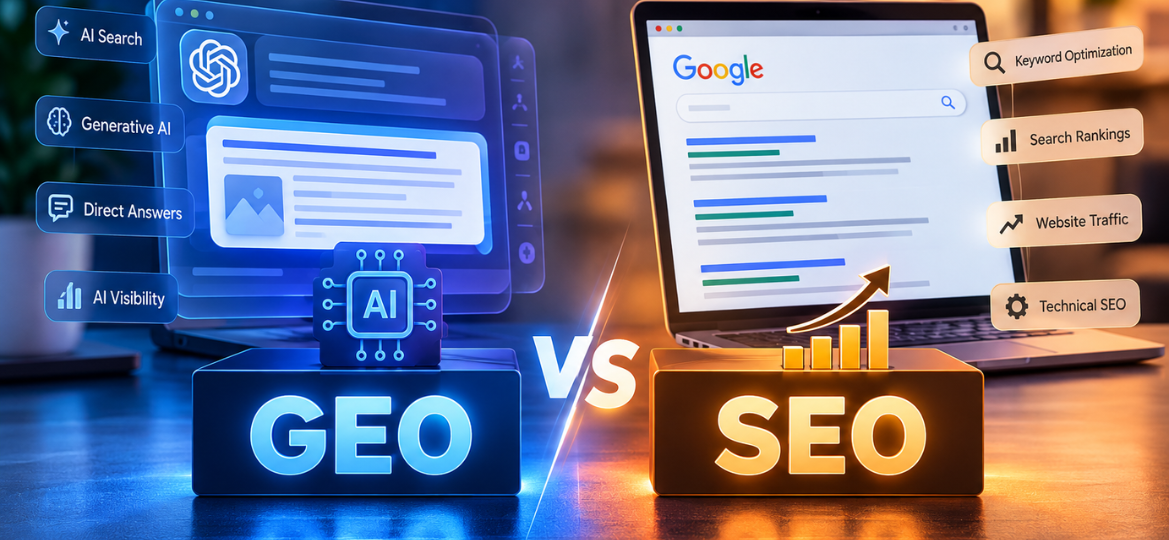
Search is no longer limited to typing a few words into Google and choosing a website from the results. People are asking AI tools complete questions, comparing several options at once and expecting direct answers instead of a long list of links.
That change has brought a new term into the SEO conversation: GEO.
But what exactly is the difference between GEO vs SEO, and does GEO mean traditional SEO is becoming outdated?
Not really. SEO and GEO focus on different parts of the search journey. Understanding how they work together can help businesses create content that remains useful as search continues to change.
For businesses such as Digitally Solve, this shift is not about replacing one strategy with another. It is about understanding where people are searching and making sure a brand can be found, understood and trusted across those experiences.
What Is SEO?
SEO, or Search Engine Optimization, is the process of improving a website so that search engines can discover, understand and rank its pages for relevant searches.
Traditional SEO covers several areas, including technical website health, keyword targeting, content quality, internal linking, page experience and authority.
For example, if someone searches for an SEO agency in Mumbai, a business wants its relevant service page to appear when that search has a strong connection to what the company offers.
SEO still plays an important role in 2026 because search engines continue to use websites, pages and established ranking systems to determine which information should be shown to users.
However, the way people interact with search is changing. That is where the discussion around GEO vs SEO becomes relevant.
What Is GEO?
GEO stands for Generative Engine Optimization. It refers to the process of creating and structuring content so that it has a better chance of being understood, surfaced or referenced by generative AI search experiences.
Instead of focusing only on where a page ranks for a particular keyword, GEO considers how clearly a website communicates information that AI systems may use when generating an answer.
Imagine someone asks an AI search tool:
“Which SEO agency can help a local business improve its Google visibility?”
The response may include information gathered from several websites rather than simply displaying ten traditional search results.
This creates a different visibility opportunity.
With GEO optimization, businesses need to think beyond individual keywords and consider whether their content clearly answers real questions, demonstrates expertise and provides information that can be understood in context.
GEO vs SEO: The Main Difference
The easiest way to understand GEO vs SEO is to look at what each approach is trying to achieve.
SEO primarily focuses on improving visibility within search engine results. GEO focuses on improving how useful and understandable a brand’s information is within AI generated search experiences.
That does not mean the two strategies should be separated.
In fact, strong technical SEO, useful content, clear site architecture and trustworthy information can support both approaches.
Think of SEO as helping search engines find and evaluate your website, while GEO places additional attention on how your information can contribute to an AI generated answer.
The two approaches overlap, but they are not identical.
Why AI Visibility Matters in 2026
The growth of AI powered search has changed what businesses mean by online visibility.
A company might rank well for a keyword but still receive less attention if users increasingly get their initial answer directly from an AI search experience.
This is why AI visibility and AI SEO have become important parts of the modern search conversation.
Businesses need to consider questions such as:
Does our content answer specific customer questions?
Is the information easy to understand?
Are important claims supported by useful evidence?
Does our website demonstrate genuine expertise?
Are our services and areas of expertise clearly explained?
These questions are useful because AI systems need context. A page that simply repeats keywords without providing meaningful information gives both users and search systems very little to work with.
Does GEO Replace SEO?
No.
This is one of the biggest misunderstandings surrounding GEO vs SEO.
Businesses should not abandon their existing SEO foundations simply because AI search is becoming more common.
Technical SEO still matters. Website structure still matters. Search intent still matters. Page speed, crawlability, internal linking and useful content still matter.
GEO should be viewed as an additional consideration rather than a replacement.
A practical strategy starts with strong SEO and then asks whether the content is also structured clearly enough for AI driven discovery.
For example, a service page should explain what the service does, who it is for, what problems it solves and why the business is qualified to provide it. This is useful for visitors, search engines and AI systems alike.
How to Prepare Your Website for GEO
You do not need to completely rebuild your website to start thinking about GEO.
Start with your existing content.
Look at your most important service pages and ask whether they answer the questions customers actually have. If the page only talks about a service in broad marketing language, consider adding specific information that makes the subject clearer.
You can also improve content by using descriptive headings, short explanations, relevant examples, FAQs and clear connections between related topics.
Another important area is consistency.
Your website should clearly communicate what your business does, who you serve and what areas you specialise in. Confusing or contradictory information makes it harder for both users and search systems to understand your brand.
This is where an experienced SEO specialist in Mira Road can help businesses identify gaps between their existing search strategy and the way modern search experiences are developing.
How Google Updates Fit Into the Picture
Google Updates will continue to affect how websites perform in organic search, which means businesses still need to monitor their SEO performance rather than assuming that one strategy will work forever.
At the same time, businesses should avoid reacting to every algorithm change by completely rewriting their websites.
A better approach is to build a strong foundation around useful content, technical quality, clear information and genuine expertise.
These principles can remain valuable even as individual search features change.
For Digitally Solve, this means looking at search visibility as a broader process rather than treating rankings as the only measurement that matters.
What Should Businesses Focus On?
The conversation around GEO vs SEO can sometimes make SEO sound outdated. In reality, the two are becoming increasingly connected.
Businesses should continue investing in SEO fundamentals while making their content easier for people and AI systems to understand.
That means writing for real questions rather than simply targeting keywords.
It means explaining subjects instead of filling pages with repeated phrases.
It means showing experience instead of making unsupported claims.
And it means keeping important business information accurate across the website.
The strongest approach is not to choose between GEO and SEO. It is to understand what each one contributes and build a strategy that accounts for both.
The Future of Search Is About Being Understood
Search visibility in 2026 is becoming more complicated, but the underlying principle is surprisingly simple: useful information has value.
SEO helps your website compete in traditional search. GEO considers how that information may be discovered and used in generative search experiences.
Understanding GEO vs SEO therefore gives businesses a clearer way to think about the changing search landscape.
For Digitally Solve, the focus is on creating practical search strategies that connect technical SEO, useful content and emerging AI driven search opportunities.
If your website needs a clearer strategy for modern search, Get in touch to discuss how you can strengthen your organic visibility.